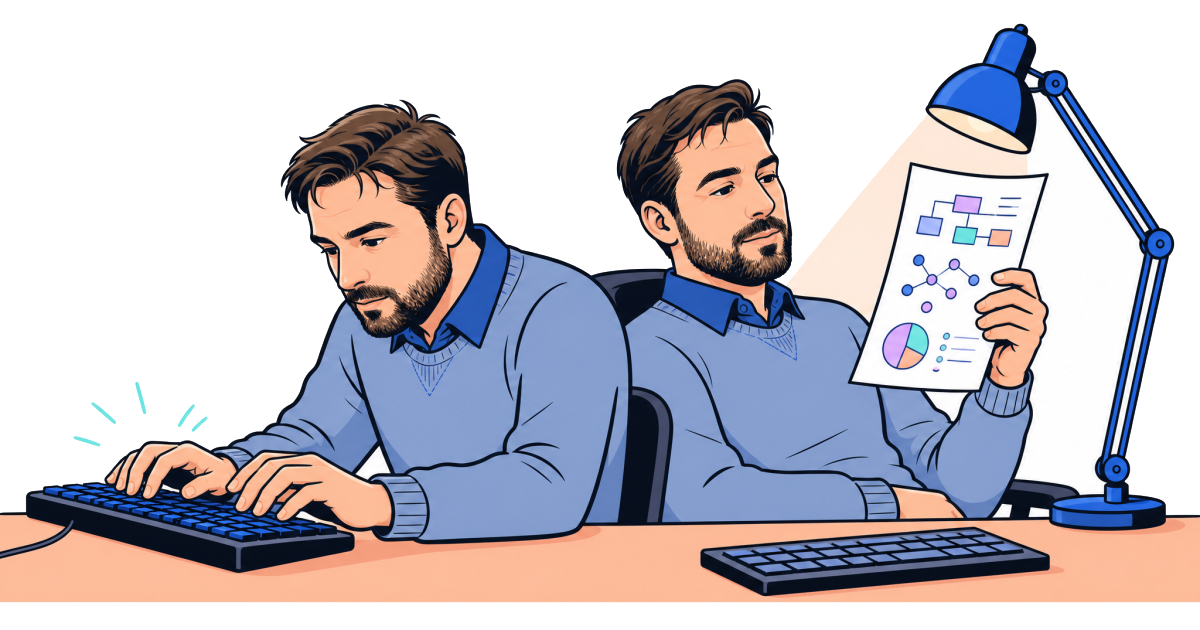
Robots write the code now, and somebody still checks the homework

You ask for a function, and you get the function. You also get three helper functions you didn't ask for, a comment explaining what a loop does, and the quiet feeling that you're not quite alone at the keyboard any more.
I've been there. I'm there most days, and I've made my share of bad calls along the way. I once approved a piece of work because it handled every case I thought to check, which turned out not to be all of them. Its confidence was persuasive. Mine was misplaced.
I'm building a SaaS with AI agents doing much of the execution: writing the code, wiring up the tests, filing the pull requests. Features that used to take a week arrive in hours. That part is genuinely useful. The part that stays with you is the homework.
The bit they leave out
Reviewing your own code is familiar. Reviewing a colleague's is a known exercise. Reviewing code produced by something that's fast, confident and has no memory of why it made a decision last Tuesday is different in ways that take a while to feel.
It's a bit like a casserole left by a very accomplished cook who's since left the building. It smells right. It looks right. You serve it, and you find out later.
The work doesn't disappear when AI does the writing. It shifts. Less typing, more reading. Less "did I get this right?" and more "did I ask for the right thing in the first place?" Those are not the same question, and the second one is harder.
What this is for
I'm an engineer and architect, and I write about one problem at a time, the way I'd explain it over coffee: what it looks like in practice, the trade-off, what it costs, where it stops working. Not a science article. Not a pitch for anything.
The reader I have in mind is anyone curious about how software actually gets made now: an engineer, a manager, a founder, or someone who works alongside people who build. You don't need to write code to follow along.
The questions the posts keep coming back to: what does working with AI actually make possible, and where does it still need a careful eye? I build this way, I trip over things, and I write about them afterwards.
If you're curious about what building software looks like now that you're no longer the only one at the keyboard, you're in the right place.